
Santa Paula's Historical City Directory Shelf
Santa Paula volume research starts with a shelf question: is the book titled for Santa Paula, for Ventura County, or for a publisher's regional run? The strongest verified local repository is the Museum of Ventura County Research Library, while Blanchard Community Library is the practical first stop for reference questions, newspapers, yearbooks, and uncataloged local files. The table keeps verified examples separate from runs that still need a librarian's confirmation.
Dates below describe what the research located, not a promise that every year survives. In particular, the complete run of the 1974 Santa Paula volume, an exact reverse-directory run, and a named obituary index have not been verified.
| Collection | Years | Where Held | Access |
|---|---|---|---|
| R. L. Polk's Polk's Santa Paula, Fillmore City Directory | 1974 verified example; complete run not located | Museum of Ventura County Research Library and Blanchard Community Library; catalog evidence also appears in Santa Barbara County Genealogical Society material | Ask for the volume and full shelf run through reference staff |
| Polk's Ventura County (California) Directory | 1961 verified title and contents | Reference or digitized title and contents; local copy location needs confirmation | Verify the title page, contents, abbreviation key, and entry page |
| Reverse or criss-cross directories | Exact Santa Paula run not verified | Ask Blanchard and Museum reference staff for county, suburban, or address-order volumes | In-person search if a local or regional volume is held |
| Federal population census | 1850-1950 public; 1950 is the newest public schedule | NARA, FamilySearch, and library databases | Search by enumeration district, household, or address where the database allows |
| Newspaper microfilm | Santa Paula Chronicle 1888-1992; Santa Paula Review 1928-1949; Santa Paula Times 1993-2003 | Museum Research Library microfilm and local library or archive aids | Reference appointment or local archive assistance |
| Sanborn fire-insurance maps | February 1912, 14 sheets | Library of Congress digital collection | Free sheet browsing; maps show buildings and use, not a people roll |
| Ventura County recorded and vital records | 1873 forward in the county record system | Ventura County Clerk-Recorder and historical library or FamilySearch catalog routes | County appointment, certificate route, or historical reference help |
A gap is evidence about access, not an invitation to fill in a publisher or year. A reference librarian may find a countywide volume that a town-name catalog search misses, but the exact title and page should be recorded before a directory fact is cited.
Where Santa Paula City Directories Are Shelved
Blanchard Community Library should be asked first about Santa Paula volumes, telephone books, reverse directories, yearbooks, obituary files, Santa Paula Times or other newspaper microfilm, Sanborn access, Ancestry Library Edition, and HeritageQuest. Its official public pages did not provide a verified publisher-by-year shelf list, so the reference desk is the right place to check uncataloged vertical files and donor material.
The Museum of Ventura County Research Library is the strongest verified one-stop repository. It is free and appointment-only Wednesday-Friday from 11:00 a.m. to 5:00 p.m. at 100 E. Main Street in Ventura. Contact library@venturamuseum.org or 805-653-0323 extension 320. The same visit can connect directory work with county property, voter, court, map, newspaper, and family-history records.
- City and county directories, census records, voter indexes, and assessor or property records.
- Court records, government and corporate files, club records, maps, architectural drawings, and incorporation files from the 1870s forward.
- Personal and family papers, clipping files, biographical files, and other local-history ephemera.
- More than 425 oral histories and image holdings exceeding 100,000 prints and negatives.
- More than 3,300 postcards and 2,300 slides that can add place and community context.
Ask staff to search both Santa Paula and Ventura County terms. Small-city directory entries are often cataloged by county or publisher, and a reference file may bridge a missing printed volume without pretending that the file is a complete directory run.
Verified Santa Paula City Directory Volume
The clearest Santa Paula-specific example is R. L. Polk's Polk's Santa Paula, Fillmore City Directory from 1974. The title and year are verified in the research record, but a complete run was not located. That distinction matters. A confirmed 1974 volume supports a targeted request, while it does not establish that 1973, 1975, or every intervening year is held locally.
A second verified reference point is the 1961 Polk's Ventura County (California) Directory. Its title and contents identify alphabetical businesses and private citizens, householders and office occupants, a street-and-avenue guide, a numerical telephone directory, and a classified section. Santa Paula is abbreviated as (SP). Use the printed key and locality mark rather than assuming that every regional volume treats Santa Paula as its own standalone book.
The 1961 contents also show why a printed volume is more than a name list. A forward entry can carry a name, address, occupation or business context, and telephone information. The street-and-avenue guide changes the search direction. Spouse, widow, ownership, and tenure symbols were not verified for Santa Paula, so they should not be added to a transcription or inferred from a generic directory habit.
Read a Santa Paula City Directory Entry
A careful reader transcribes the visible field and its section before drawing a family conclusion. In the verified 1961 regional contents, Santa Paula's locality code is part of the address context, and the book separates forward names from street, telephone, and classified material. The sample inventory below describes those verified elements without inventing a local symbol key.
When a page image or physical copy is available, photograph the title page, publication year, contents, abbreviation key, and the exact entry page together. That small citation trail protects against a later mix-up between a county volume, a neighboring locality, and a Santa Paula entry.
| Name | The name as printed in the alphabetical business or private-citizen section. |
|---|---|
| Locality | The verified 1961 abbreviation (SP) for Santa Paula. Check the book's own key. |
| Address | Street address in a forward listing, with a separate street-and-avenue guide for address order. |
| Occupation or business context | Printed context attached to the listed person or organization; it is not proof of title or residence beyond the listing. |
| Telephone | Information in the numerical telephone section or beside an entry where the volume supplies it. |
| Reverse clue | A street-order line can connect a number to a listed adult or business when the reverse section is present. |
| Unverified marks | Spouse, widow, ownership, and tenure marks were not established for Santa Paula. Do not assume them. |
- Criss-cross directory
- An address-order section that starts with a street and number rather than a person's name. Exact Santa Paula years remain unverified.
- Householder index
- A name-oriented section for listed householders or occupants. It is a finding aid, not a complete list of everyone at an address.
- Abbreviation key
- The volume's own explanation of locality, street, telephone, and other short forms. Read it before expanding an entry.
- Index versus image
- An index points to a name or address. The scanned page or physical volume is the evidence to cite when the two differ.
Santa Paula City Directories in Reverse Order
Reverse pages are the bridge between a known address and a historical listed adult. Look for the street, number, and nearby sequence, then turn back to the forward alphabetical section to confirm the spelling and locality. The method is especially useful when a family name changed, a person used a nickname, or a directory omitted a household member from the main listing.
The exact Santa Paula reverse-directory run has not been verified in an official online shelf inventory. Ask both Blanchard Community Library and the Museum of Ventura County Research Library for Santa Paula, Ventura County, telephone, suburban, and criss-cross variants. If no reverse volume is held, census schedules, newspapers, deeds, permits, and Sanborn maps can supply different pieces of the address history without being mislabeled as a directory.
A reverse entry is an occupant clue around publication time. It is not a deed, a complete household roster, or proof that the person remained at the address after the volume was printed.
Santa Paula Newspapers Fill Directory Gaps
Newspapers give the Santa Paula directory trail dates and relationships that a compact entry may omit. The verified microfilm runs are the Santa Paula Chronicle from 1888-1992, the Santa Paula Review from 1928-1949, and the Santa Paula Times from 1993-2003. Search publication date and page for obituaries, wedding notices, school items, club reports, business advertisements, legal notices, and address clues.
The Museum of Ventura County Research Library is the verified local route for the microfilm and related clipping or biographical files. No exact Santa Paula obituary-index run was verified, so a newspaper result should be cited as a newspaper result rather than described as an index entry. Record the report date, page, names, relatives, organizations, and whether the item is contemporary or a later reminiscence.
Note: A newspaper can connect a name to a relative or event, but publication does not make every detail an official residence record.
A 1912 Santa Paula Map Context
The Library of Congress holds a verified February 1912 Santa Paula Sanborn atlas with 14 sheets. The Santa Paula Sanborn catalog record and its sheet browser can help place a building footprint, street name, use, and number context beside an older street entry.
Sanborn sheets are maps, not occupant rolls. They can show whether a structure existed and how it was labeled near the map date, but they do not name every person who used it. Pair a sheet with the directory's street guide, a census schedule, a deed legal description, or a newspaper item. The map is especially useful when an older street reference does not line up with a modern parcel.
Santa Paula History Behind the Volumes
Jurisdiction sets the outer limits of a local directory search. Santa Paula was founded in 1872. Ventura County was organized in 1873, and county Clerk-Recorder records are described from that boundary. The city incorporated on April 22, 1902. A record from before incorporation cannot be a City of Santa Paula council or permit record, while an earlier family or land event may belong to the Santa Barbara County era.
The town map recorded in 1875, the post office in 1877, the railroad in 1887, oil development in 1888, and Union Oil in 1890 help explain why newspapers, maps, business notices, and regional directories matter alongside name listings. Use the timeline as a routing aid, not as a claim that a directory existed in each year.
| 1872 | Santa Paula was founded, before the later city incorporation. |
|---|---|
| 1873 | Ventura County was organized; county official and vital-record coverage is described from this boundary. |
| 1875 | Nathan Blanchard and Elisha Bradley's town map was recorded, creating an early map reference. |
| 1902 | Santa Paula incorporated on April 22, establishing the city jurisdiction for later municipal records. |
| 1912 | The verified Library of Congress Sanborn atlas provides 14 sheets for building and street context. |
| 1950 | The 1950 federal population schedule is the newest public census schedule under the 72-year rule. |
The 1890 federal population schedule is largely lost nationally. Directory pages, voter or poll material, deeds, maps, and newspapers are the practical bridge for that decade, with each source labeled for what it actually shows.
Trace Santa Paula Households Through City Directories
A household trail works best when one known year anchors the next. Transcribe a directory line exactly, then move forward and backward through adjacent volumes. Pair the adult listing with a census schedule, newspaper notice, deed, permit, probate item, or cemetery record rather than treating an unexplained gap as proof of a move or death.
Compound surnames, maternal and paternal surname order, accents, anglicized spellings, nicknames, and married or birth surnames can change how a Santa Paula entry appears. Search both surnames separately and together. A shared surname is a lead, not proof of a family relationship.
- Anchor one known year. Transcribe the name, address, locality mark, occupation or business context, telephone information, and the book's abbreviation key.
- Search adjacent years. Record first appearance, last appearance, address changes, context changes, and spelling variants without silently normalizing the printed form.
- Turn to street order. Use a reverse or criss-cross section to see the number sequence and nearby listed adults, then confirm the name in the forward section.
- Pair the census. Compare the closest 1900-1950 federal census to learn relationships, ages, birthplace, and household members that an adult-focused directory may omit.
- Bridge the blank years. Check the exact newspaper runs, deeds, voter or poll records, school material, permits, probate, and cemetery records held by the appropriate custodian.
- Check address changes. Compare legal description, subdivision map, Sanborn sheet, APN lineage, and any verified street cross-reference before concluding that a household moved.
If a name disappears, test several explanations: the person moved, died, changed surname, went unlisted, or the volume has a gap. When a historical address needs a modern parcel check, the Santa Paula street directory address chain supplies the current Assessor, GIS, deed, permit, and jurisdiction path.
Note: An adult directory listing places a person near a publication date; it does not establish a complete household or title interest.
Santa Paula Historical Society City Directory Leads
The Santa Paula Historical Society PastPerfect collection is a verified online starting point for local photographs, oral histories, school and business ephemera, and family files. Access and donor limits still need to be confirmed for a specific item. A searchable object record can supply a name or place lead, but it should not be treated as a public member roster.
The collection view below is useful when a directory entry needs a local image or community context. Search the person, family, school, business, or street term, then record the object title and source details before connecting it to a directory line.
The Historical Society's online collections catalog is the source for this local-history research image.
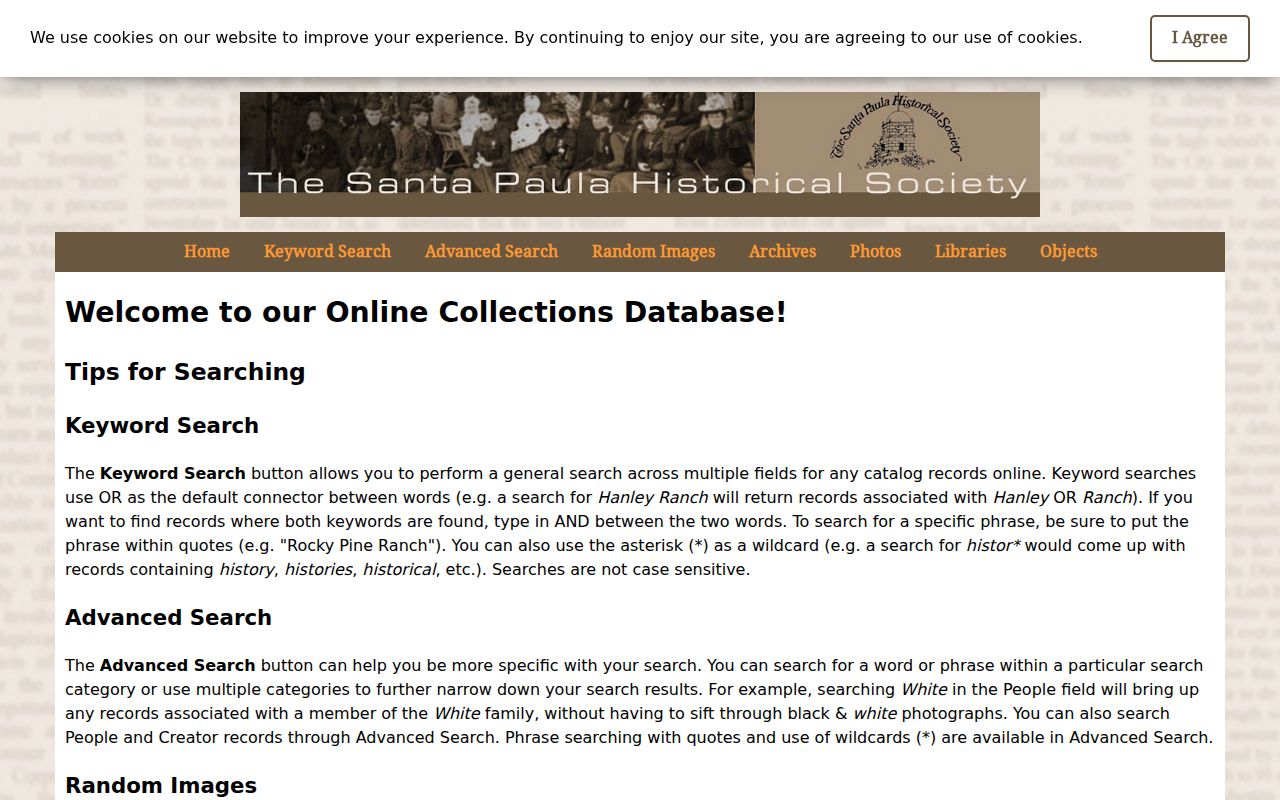
This Historical Society view complements the printed volume by preserving local objects that can help confirm a school, business, family, or place without claiming that every named person is a current resident.
Santa Paula Local Context Today
The city's official Santa Paula Fast Facts page supplies civic context for reading older volumes. Santa Paula lies in the Santa Clara River Valley and is associated with citrus and agriculture, oil, rail transportation, and aviation. Those themes help explain why a directory entry may connect with a packinghouse notice, an oil-era business, a railroad reference, a school record, or an aviation collection.
The same official local-history source reports a 2020 Census population of 30,657. Treat that number as civic context, not as a directory count. The city also has deep Mexican and Mexican-American community history, so name research should preserve compound surnames, accents, particles, nicknames, and married or birth surnames rather than treating spelling variation as a different family without checking.
The City of Santa Paula's Fast Facts page is the source for this local context image.
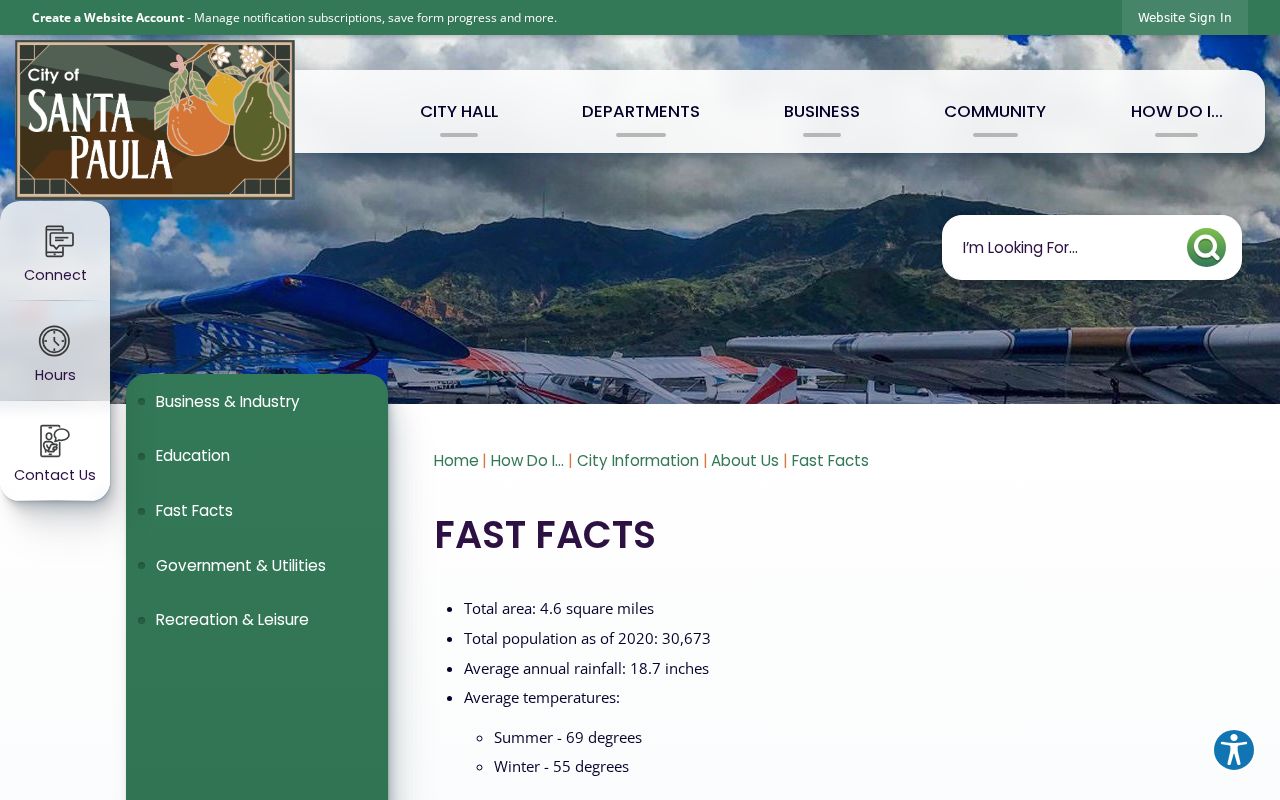
Local geography, civic history, and directory evidence work best together. Use the city source for place context, the library or museum for the historical shelf, and the directory page itself for the exact name, address, and date being cited.