
Santa Paula Previous Residents by Era
A useful previous-residents search starts with a source map. Ventura County records, local history collections, federal schedules, and city files answer different questions. A deed is strongest for title. A directory or census is better for household presence. A permit dates a project, but it does not prove that the applicant lived there. Keeping those roles separate prevents a neat-looking timeline from becoming an unsupported claim.
| Source | Years It Covers | Where Held | What It Shows |
|---|---|---|---|
| Recorded deeds and vital records | Ventura County office coverage from 1873 to present; remote index cutoff unverified | Ventura County Clerk-Recorder, by appointment or counter | Owners, transfers, legal descriptions, and family-event records |
| City and reverse directories | Exact Santa Paula runs not fully verified; a 1974 Polk title is documented | Museum of Ventura County Research Library and Blanchard Community Library | Named adults, addresses, occupations, and street-order clues |
| Federal population census | 1850 to 1950 public schedules | NARA, FamilySearch, and library databases | Household members, relationships, ages, birthplace, occupation, and tenure |
| Santa Paula Sanborn maps | February 1912, 14 sheets | Library of Congress | Building footprint, use, street context, and historical numbering clues |
| Permits and code files | Online archive start not located | Santa Paula Building & Safety or city records request | Project address, scope, applicant, contractor, and dates |
| Newspapers, obituaries, and probate | Chronicle 1888 to 1992; Review 1928 to 1949; Times 1993 to 2003 | Museum research library, court, and local history collections | Kin, moves, civic ties, death details, and estate transfers |
Start with the present parcel when the goal is house history. Move to the deed chain for owners, then insert occupants from directories and census schedules. If the address is older than the county record boundary, route the search to Santa Barbara County-era civil, mission, church, and historical sources instead of assuming a missing Ventura image.
Santa Paula APNs Start House History
Resolve today’s physical address before looking for previous residents. A previous residents trail begins with the Ventura County Assessor Property Search, designed around a street address or Assessor Parcel Number, or APN. County View adds the mapped parcel shape and jurisdiction layers. Search by situs address, which means the place where the parcel sits, and write down the APN, unit, ZIP, jurisdiction, and any legal-description clue returned by the record.
The owner mailing address is a different field. It may point to a trust, a management office, an absentee owner, or a preferred place for tax notices. It does not establish where that person sleeps. California also limits owner-name display in an Internet assessor view, so a name may require a lawful counter or public-record request. The APN and legal description are the better continuity keys when a street number changes, a parcel splits, or a rural road gains a modern name.
House-history rule. Treat APN, situs address, mailing address, and legal description as four separate clues. Use two independent records before identifying a prior resident.
Santa Paula Deeds Run Backward
The Ventura County Clerk-Recorder is the key source for a title trail. The current vesting deed names the parties who transferred title and supplies the recording date, document number, and legal description. In a grantor and grantee index, the grantee is the person or entity receiving an interest. The grantor is the person or entity giving it. Searching the seller as an earlier grantee is the basic move that carries the chain backward.
Use the actual instrument to test each index hit. Names can repeat, trusts can hold title, and a quitclaim or interspousal transfer can alter the index without a household move. A lien or release can mark a date, but it is not by itself proof that anyone lived at the address. Legal descriptions matter more than a street number when old records and modern maps do not line up.
- Pull the current APN and legal-description clues from the Assessor and County View.
- Ask the Recorder for the vesting deed, its recording date, and its document number through the verified appointment or counter channel.
- Search the current owner as grantee, then record every party, role, document type, date, and legal-description clue.
- Carry the grantor backward as the earlier grantee, testing spelling variants, spouses, trustees, estates, and entity names.
- Stop at the remote boundary and request counter, book, microfilm, or historical-catalog help rather than guessing at an older gap.
- Chain of title
- The linked sequence of recorded transfers that explains how an interest moved from one party to the next.
- Legal description
- The lot, block, subdivision, or metes-and-bounds wording that identifies land more reliably than a postal address.
- APN
- The Assessor’s administrative parcel number used to join property and map records; it is not the deed’s legal description.
- Instrument
- The recorded document itself, such as a deed, trust transfer, quitclaim, lien, or release.
Santa Paula Recorder Search Limits
Ventura’s official material confirms county records from 1873, but it does not verify an exact remote index cutoff. The self-service gate at Ventura County Recorder official records warns that an index is like a card catalog, not the instrument. It also advises searching every spelling variation and trying other criteria. That warning matters when a previous resident used a middle initial, a married surname, a Spanish compound surname, or an abbreviated entity name.
Public searching is verified by appointment at county offices, with the Recorder division at the Ventura County Government Center, 800 S. Victoria Avenue. The published contact is 805-654-3665. Ask the counter staff to explain whether an older deed is indexed, whether an image can be viewed or copied, and which book or legal-description clue will carry the search farther back. The FY 2025 to 2026 fee schedule and current appointment rules should be checked before travel.
Note: The 1873 office start is not a claim that every 1873 image is online or remotely searchable.
The 1912 Santa Paula House Map
For a structure that predates modern parcel tools, the February 1912 Santa Paula Sanborn atlas gives a fixed point between household records. The Library of Congress catalog identifies 14 sheets. These fire-insurance maps show footprints, construction clues, street names, uses, and numbering context. They do not list occupants. Compare the sheet index, the building shape, nearby roads, and the legal description or APN lineage before matching a map feature to today’s address.
The map is especially useful when a street description looks unfamiliar. A directory can place an adult at an address, while the Sanborn sheet can show whether a building stood there and how it was arranged. The result is stronger when a census year, directory year, deed description, and map feature point to the same place. Do not use a map alone to name a previous resident.
Santa Paula Directories Meet Census
Directories supply the occupant layer missing from a deed. The Museum of Ventura County Research Library is free and appointment-only Wednesday through Friday, 11:00 a.m. to 5:00 p.m., at 100 E. Main Street in Ventura. Its published holdings include city and county directories, voter indexes, census records, assessor and property records, court records, maps, newspapers, family papers, and oral histories. Contact library@venturamuseum.org or 805-653-0323 extension 320. Blanchard Community Library is another local reference stop, but its exact directory shelf run should be confirmed with staff.
A verified example is R. L. Polk’s Polk’s Santa Paula, Fillmore City Directory from 1974. A 1961 Ventura County Polk volume shows the kind of fields a reader may encounter: alphabetical businesses and private citizens, householders or office occupants, a street-and-avenue guide, a numerical telephone directory, and a classified section. Santa Paula may be marked with the abbreviation “SP.” Spouse, widow, owner, and tenure symbols were not verified for the local run, so copy an abbreviation key before interpreting one.
Pair each directory year with the closest public census rather than treating either source as complete.
- Transcribe one known directory entry exactly, including initials, address, occupation, and any abbreviation key.
- Check the next available volume forward and backward for first appearance, last appearance, address change, and spelling variation.
- Use the reverse or criss-cross section to read the street number, then compare it with the alphabetical entry.
- Pair the result with a 1900, 1910, 1920, 1930, 1940, or 1950 census schedule and note household relationships.
- Bridge gaps with newspapers, yearbooks, deeds, probate, cemetery records, and clearly labeled project permits.
The historical directory collections themselves belong with the Santa Paula city directory collections. Here they function as time points in a single-address trail.
Santa Paula Permits Date Projects
Santa Paula Building & Safety at 200 S. 10th Street can help with address-specific permit history. Its posted number is 805-933-4218, and counter hours are 8:00 a.m. to noon and 1:00 p.m. to 4:30 p.m. on weekdays, with alternate-Friday closures. No official address-searchable permit archive was verified. Ask for a particular address, date range, permit number, project type, or inspection record, and distinguish the owner, applicant, contractor, agent, and contact roles.
When a file is not posted, the Santa Paula JustFOIA public-record request portal is the fallback. A California Public Records Act request should name the department, address, date span, case or permit number, and preferred electronic format. The city must determine whether identifiable records are disclosable within 10 calendar days, with a written extension of up to 14 days for unusual circumstances. A project completion date can establish when work occurred. It cannot establish when a family moved in.
Before 1873, Santa Paula Records
Santa Paula was founded in 1872, while Ventura County was created from Santa Barbara County and organized in 1873. Santa Paula city records begin later, after incorporation on April 22, 1902. That geography explains why a search for earlier previous residents may leave the Ventura County Clerk-Recorder trail. Route the gap to Santa Barbara County-era civil records, mission and church sources, historical newspapers, and family collections. A missing modern index is not evidence that a person or house was absent.
Historic addresses also need care. Santa Paula’s Nathan Blanchard and Elisha Bradley town map was recorded in 1875, the post office came in 1877, and the railroad arrived in 1887. Rural routes, tract descriptions, road names, and later numbered addresses can refer to the same place. Compare the legal description, map sheet, directory street guide, and APN lineage before declaring that an earlier household lived somewhere else.
Santa Paula Heirs and Obituaries
Previous residents often disappear from a deed chain because a death, inheritance, or trust transfer changes the indexed party. Probate can identify a decedent, petitioner, representative, heirs where filed, and property disposition. Ventura Superior Court’s civil and probate portal is a starting index, while restricted or missing documents require the court records counter. An obituary may add relatives, an address, a church, a cemetery, or a move that the title record never mentions.
Local newspaper runs give Santa Paula’s house history a useful time scale. The Santa Paula Chronicle runs from 1888 to 1992, the Santa Paula Review from 1928 to 1949, and the Santa Paula Times from 1993 to 2003 in the Museum research holdings. Record the publication date and page. A later reminiscence is not the same as a report made near the event. Cemetery and vital-record evidence can support a family connection, but certified copies have separate eligibility rules.
House-history boundary. Previous residents research in Santa Paula is appropriate for genealogy, heir work, and personal curiosity. Do not use a record trail to stalk, harass, threaten, or track a living person.
Present Records Do Not Name Previous Residents
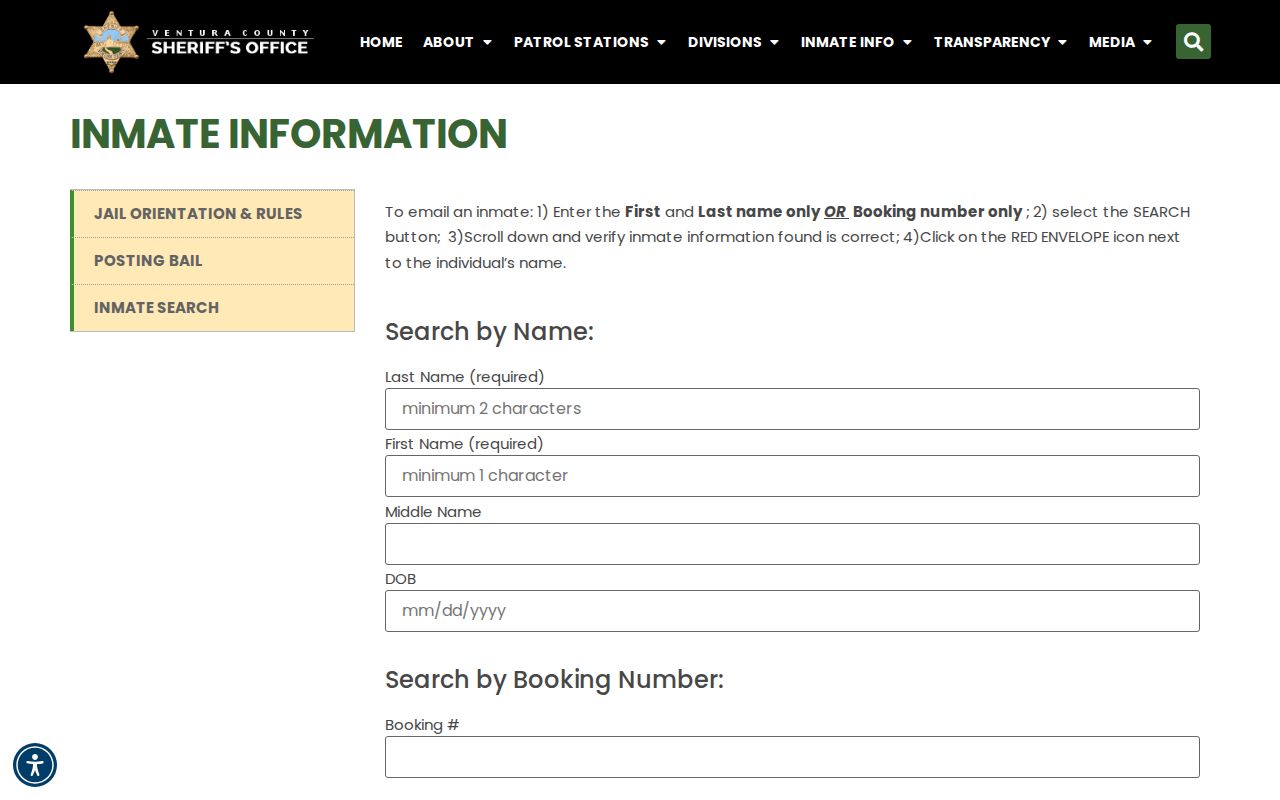
Some official records belong in a boundary check, not in a historical timeline. The Ventura County Sheriff inmate information page is a present-day law-enforcement source. It may help a reader understand where current custody information is held, but it is not evidence that a person lived at a Santa Paula address in the past. No historical conclusion should be drawn from a custody listing.
The same discipline applies to every source: an owner is not automatically an occupant, an applicant is not automatically a resident, and a name match is not identity proof. Keep the date, role, source, and confidence level beside every entry in the timeline. The strongest previous-residents account is a modest one that says exactly what the record shows and stops where the record stops.
The Ventura County Sheriff’s official information page illustrates the modern boundary between a current public record and historical house evidence.
That distinction keeps a Santa Paula previous-residents search focused on deeds, directories, census schedules, maps, newspapers, probate, and other sources that actually speak to time and place.